Part of a combined session, or on its own

Gua sha for women in Whaley Bridge, near Stockport and the High Peak

A smooth-edged tool worked across lubricated skin, releasing tension so effectively that many people feel looser the moment the treatment ends.

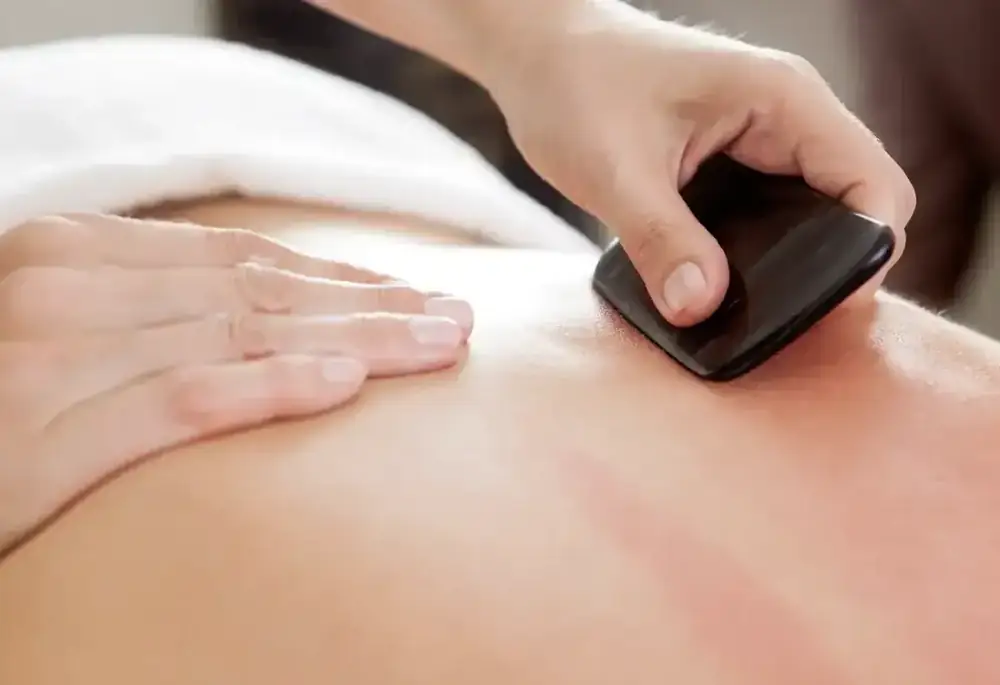
A gua sha tool being drawn across someone's upper back during treatment.

What gua sha is

Gua sha, also called scraping massage, uses a smooth-edged tool, traditionally jade or buffalo horn, worked repeatedly across an area of lubricated skin. The aim is to intentionally raise ‘sha’, a transitory therapeutic petechiae representing a small, controlled leakage of blood into the subcutaneous tissue just beneath the skin. Raising sha opens the pores, improves blood flow and clears stagnation that has settled in the area.

A single treatment can bring immediate relief from pain, stiffness, fever, cough or nausea, and it works well across both acute flare-ups and longer-standing, chronic patterns. Described as a scraping massage, it doesn’t sound like much on paper, but the experience itself is genuinely liberating. Gua sha reaches deeper than cupping does, and the freedom of movement that follows a treatment is often immediate.

The sha it leaves can look like bruising, and usually resolves within about a week; swimming and direct exposure to wind or cold are best avoided for the rest of the day afterwards. Arya Nielsen, PhD, has written the standard scientific text on the therapy, Gua Sha: A Traditional Technique for Modern Practice, for anyone who wants to read further.

Conditions this can help with

  • Upper or lower back pain
  • Neck pain
  • Weak legs
  • Arthritis and gout
  • Stress and fatigue
  • Digestive disorders
  • Fertility support
  • Menstrual pain and other chronic pain
  • Muscle tone
  • Sports injuries
  • Weak immunity
  • Feeling cold, or a low metabolism
  • Asthma and allergies
  • Colds, flu, or a cough with mucus
  • Eczema
  • Fibromyalgia
  • Headaches and migraines
  • Chronic hepatitis
  • Breast distension or mastitis
  • And much more, depending on your individual pattern

Why I use it

Gua sha is usually used after acupuncture, or alongside it in the same session. The needles work first from the inside: they settle the nervous system, ease pain signalling and let muscles that have been guarding begin to soften. Gua sha then works from the outside, on the surface layers and the fascia, finishing what the needling has started.

It breaks down adhesions. Muscles are wrapped in layers of fascia that should glide smoothly over one another. After injury, overuse, long hours at a desk or years of holding tension, these layers can stick together, so a muscle can no longer lengthen and contract freely. The firm, repeated strokes of the gua sha tool create a shearing force through the tissue that loosens these adhesions and restoresneighbouring muscles that were compensating can stop overworking, which is often where the ache really came from.

It floods the area with blood. Research measuring blood flow in the skin has shown a several-fold rise in circulation at the treated area straight after gua sha, persisting well beyond the treatment, together with pain relief both where the tool was used and further away from it. Animal research suggests that gua sha also activates one of the body’s own protective, anti-inflammatory enzymes, which may explain why the relief can last well after the marks have faded.

Why it works so well with acupuncture. The two approaches meet the same problem from opposite directions. Acupuncture changes the signalling: how the nervous system perceives pain, how tightly it holds the muscles, how well it regulates blood flow. Gua sha changes the tissue itself, freeing stuck layers and restoring circulation. When the needles come first, the muscles are already softer and less guarded, so gua sha is more comfortable and reaches deeper with less effort. And once the fascia can move again, the calmer patterns the nervous system has begun to learn have a body that is physically able to follow them, so the change is more likely to hold.

It also pairs well with fascia work and cupping in the same session, depending on what your body is showing on the day.
A candlelit treatment room set up for a calming massage.

Research summary

What the evidence says

Gua sha has some of the better-quality randomised evidence among manual therapies. Trials report meaningful reductions in pain intensity for chronic low back pain and chronic neck pain, with more recent research also finding measurable effects on fascia thickness and pain in Parkinson’s disease.

Common questions

Will gua sha leave marks?›

Yes, the 'sha' looks like light bruising and resolves within about a week. It's a normal, expected part of the treatment, not a sign anything went wrong.

Is there anything I should avoid afterwards?›

Swimming, and direct exposure to wind or cold, are best avoided for the rest of the day, since the treated area is more sensitive to temperature immediately after.

Ready to begin?

Book a session and we will meet what is here, together.

Book initial consultation See sessions & prices
Book nowWhatsAppPrices