
Presence
Full attention, unhurried, so your body has room to show what it needs.
Acupuncture, Somatic Bodywork & Herbs in High Peak
The same women keep finding their way to me: exhausted, in pain, and quietly convinced their bodies are betraying them.
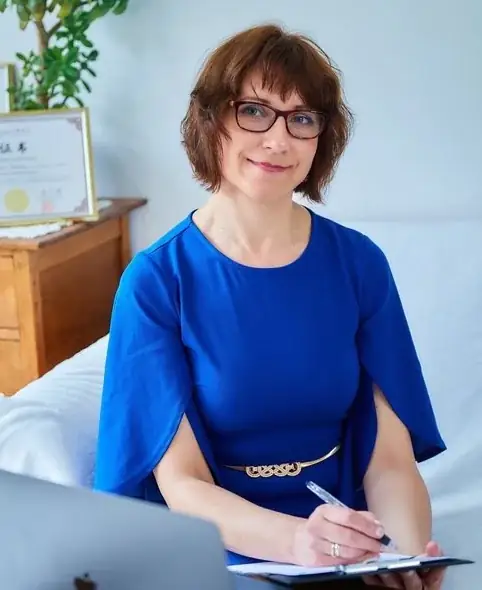
Ela Pękalska, PhD, Dip.Ac, Dip.Tui Na, Dip Herb.
Touch is very important to me, nearly sacred. As a child, I used touch to "heal" my dolls and teddy bears. Later, I learned massage techniques and practised them diligently on family and friends, and through persistence and experimentation, I became effective. Touch was how I understood care, and that instinct stayed with me even when my working life took a different path.
I have an inquisitive mind that questions conventional knowledge, including my own. I love ideas that shake my foundations and push me to re-evaluate who I am and what I want to experience in life. More than once, earthquakes of new thought have brought down the carefully built houses of my beliefs. The whole world has collapsed many times, and each time I have survived and learned to adjust.
I am a tester. If I like an idea, concept, or method, I test it extensively and refine it through experience. It is a fast way to build skill and intuition and to keep refining my techniques.
My main path was science. I earned a PhD in pattern recognition, which meant teaching computers to recognise patterns, and I graduated with distinction. I loved it deeply and spent years at universities in the Netherlands and the UK, finding structure in complexity.
Then my three children arrived in quick succession, each with health challenges. The vision of a blissful life with sweet little babies proved untrue, and, honestly, I was not prepared to be a mother. I brought my problem-solving mind to helping them become well, but it failed. Being well turned out to be far harder than any mathematical problem, and I was devastated.
The helplessness was overwhelming. I lacked knowledge, understanding and guidance, and I felt deeply alone, trapped in vicious circles of ignorance and stress. Even doctors couldn’t help. But I intuitively knew my children could get better, even though I didn't know how, so I set out to find a way.
I began with books and online courses, reading like crazy. I slept very little for years and got through it thanks to yoga nidra. I tested what I learned on myself and my children, largely through trial and error guided by intuition. I tried multiple therapies and paid professionals, learning what worked and what did not. Some helped more than others, and some were dead ends, but overall it was too little to make a breakthrough. I needed my own way.
Among the promising directions I found were Chinese medicine, herbs, and osteopathy, and I began to learn and apply them. Over time, my children benefited tremendously. Their health improved, and their learning difficulties eased too. I was astonished. Compared with many holistic approaches, touch (Tui Na massage, paediatric massage, myofascial release, acupressure) and herbal medicine stood out, and I wanted to learn them professionally, to take charge of the health adventure I was in.
Just as I had understood patterns in data, I slowly began to understand patterns in people. What the body in front of me showed me, what the visual inspection of the tongue, complexion, or ears indicated, how the pulse felt, how the voice sounded—all that mattered. Instead of testing mathematical hypotheses, I explored and tested what bodies presented. I trained in these traditions and, over years of work, watched my children thrive. That experience changed my life's direction. I came to understand how profoundly the body and mind influence each other, and that the split exists only in the Western approach. Real change becomes possible when you look at the whole person and work with the physical body.
As my understanding of wellbeing deepened, I changed course. The shift came when I allowed my mind to explore fully and replaced the joy of contributing through creative thought with the joy of helping others become integrated Selves. It also lets me consolidate approaches and hold together paradoxes across different healing traditions.
Eighteen years on, I am still studying. I read, take courses and continue to learn from the people I treat. As a therapist, I remain a scientist at heart: my curiosity now works alongside my hands, and I observe, question and refine what I do, seeking what helps the person in front of me rather than what ought to work in theory. I can work at depth and breadth, and integrate approaches. That combination is what I offer to help you heal.
Areas of expertise
Chinese medicine rewards depth over breadth for its own sake — but the more modalities I hold, the more I understand how they are woven together so that I can match the treatment to the person. This is what I have trained in, and what I keep training in.
Traditional Chinese Medicine diagnosis and fine-needle acupuncture, the foundation everything else is built on.
Gentle electrical stimulation through the needles for a stronger, more measurable effect on stubborn pain and injury.
Specialised needling systems used alongside classical points for fast, targeted relief where it’s needed most.
Specialised needling systems used with or outside classical points for fast, targeted relief where it’s needed most.
Chinese medical massage for adults, and a gentler version of the same techniques for babies and children.
Hands-on work with the organs and connective tissue, easing the deeper structural and digestive holding patterns.
Suction and scraping techniques that lift stagnation, ease pain and stiffness, and get circulation moving fast.
Tailored herbal formulas that support what the needles and hands have started, taken home between sessions.
Tibetan singing bowls used to calm the nervous system and deepen relaxation during and after treatment.
A PhD-trained, evidence-curious approach that tests, tracks and refines what actually works for your body.
Our values
Full attention, unhurried, so your body has room to show what it needs.

Symptoms are read together, not treated as separate problems.

You remain involved in every decision about touch, treatment and pace.
Many people arrive without the words for what is wrong. Your pulse, tongue, posture and the feel of your tissues show me a great deal. We can piece the rest together in the room.
Book initial consultation See sessions & prices